
Meet our Alumni - Professor Richard Rose

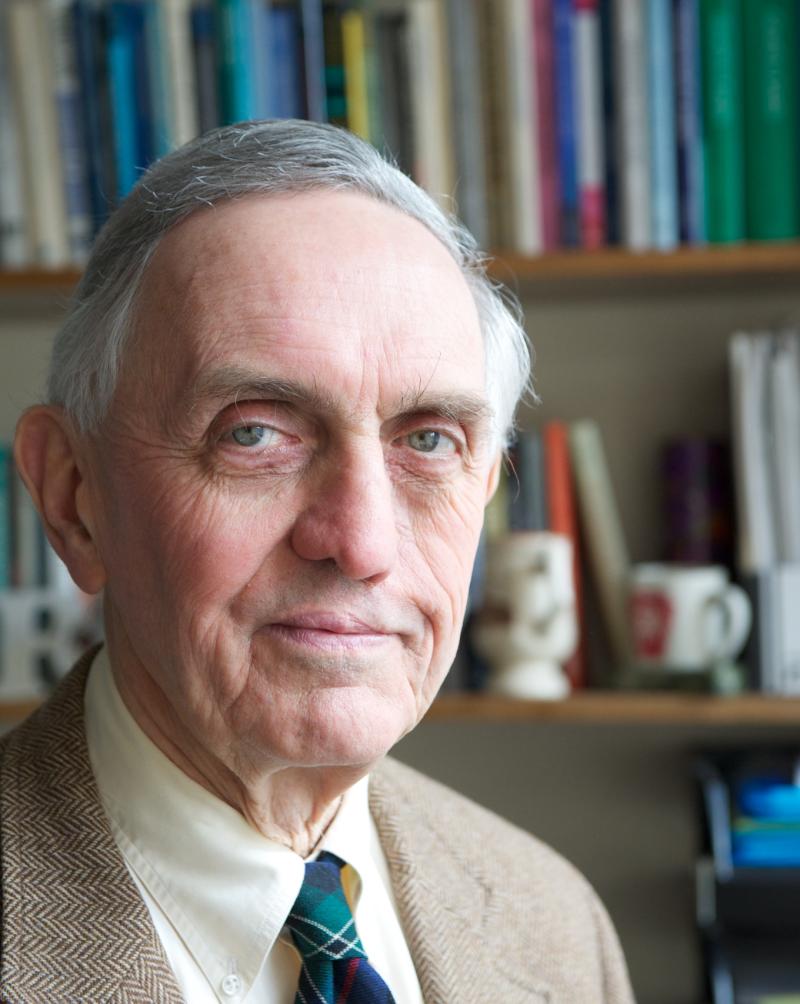
Professor Richard Rose FBA (DPhil Social Studies, 1960) is a pioneering scholar of comparative politics and public policy whose connection with Oxford stretches back nearly seven decades.
With the publication of his 61st book, The Disruption of the British Party System: Understanding the Next Election, we reconnected with Professor Richard Rose who reflected on a remarkable career.
After arriving at Oxford as a postgraduate student at Lincoln College in 1957 and later moving to Nuffield College, Professor Rose built an internationally renowned career studying British politics, elections, comparative public policy, and post-Communist societies.
Professor Rose has delivered seminars in 45 countries, had his work translated into 18 languages, and founded the Centre for the Study of Public Policy at the University of Strathclyde. Among his many achievements, his landmark 1964 book Politics in England was even circulated in samizdat form within the Soviet Union, underscoring the global reach and influence of his scholarship.
In this interview, he reflects on the Oxford experiences that shaped his thinking:
- What was the inspiration behind your 61st book, ‘The Disruption of the British Party System: A Guide to the Next General Election’?
The 2024 general election wasn’t general; 13 different combinations of parties competed for seats in 650 different constituencies. This disrupted the classic model of British two-party politics. As the holder of card number 3 in the Union of Psephologists, I wanted to investigate what the fragmentation of parties will mean for the next election.
- You've now published 61 books on politics. Looking back, what has motivated such an extraordinarily prolific writing career?
I have always liked to write. I taught myself to type at the age of eight and typed a daily wall newspaper in primary 3. Before coming to Oxford, I had achieved my childhood ambition of become a reporter on the St. Louis Post-Dispatch. I worked with ex-FBI men who were winning Pulitzer Prizes for sending corrupt presidential appointees to prison and was drilled in the discipline of finding facts. I decided to go for a doctorate because I wanted to have a deep knowledge of what I was writing about.
- What role did Oxford play in nurturing your interest in British politics and elections?
A lot. At Johns Hopkins University, where I took my BA in comparative literature, the emphasis was on Europe in the continental sense. I did a year at the LSE where Bob McKenzie and lunchtime speakers from Westminster introduced me to British politics. I found my wife and London theatres on my own. In Oxford there was an intense focus on Westminster politics, and the libraries had every publication I needed to write my DPhil thesis on the conflict between the 1945-51 Labour government’s foreign policy and Socialist principles. I was probably the first postgraduate student to collect data by interviewing politicians and I questioned dozens of MPs in my thesis from A (Clement Attlee) to Z (Konni Zilliacus).
- Your connection with Oxford stretches back 69 years. In what ways was Oxford different when you arrived as a postgraduate student at Lincoln College in 1957?
I came to Oxford thinking I was leaving journalism and found writing clever essays was the prime occupation. Postgraduate study was uncommon then. Oxford was not a university in the American or German sense. It was a collection of colleges for undergraduates, of which Lincoln was a good example. I did a standard British working week, then 44 hours, in the New Bodleian and the Oxford Union libraries working on my thesis and Sunday afternoons walked around a different college studying its architecture, architecture being a hobby of mine.
- And how did your experience change when you moved to Nuffield College, then a small postgraduate social studies community?
Greatly. I was rubbing shoulders all day with students and fellows who were interested in politics and public policy. Sir Donald McDougall and the Warden, Norman Chester, had learned practical politics in wartime Whitehall rather than reading books about political theory.
- Looking back, are there particular tutors, colleagues, or experiences at Oxford that had a lasting influence on your work?
David Butler. He was not my supervisor but ran a Friday afternoon seminar inviting politicians to talk. Since I’d finished my DPhil in two years, after the 1959 election broke out David invited me to go along for the ride when he was driving around constituencies. It was the first mass media election, with the Tories running a “You’ve never had it so good” advertising campaign and slick Labour television programmes that contrasted with Harold Macmillan’s outdated style of public speaking. My Pulitzer training enabled me to get a big scoop – how much the Tories spent on advertising - and it was debated in the Commons. I also took the lead in interviewing both Conservative and Labour headquarters staff and was the first Oxford person to research the public opinion files of the Gallup Poll and of Mark Abrams. David promoted me to co-author of the 1959 Nuffield election study. A caller to Nuffield, the Norwegian Stein Rokkan, invited me to participate in his first European conference organised with Mary Lipset. It converted me into a European political sociologist.
- After 61 books and a distinguished career, what achievements are you most proud of?
I like to follow Ezra Pound's injunction, ‘Make it New’, and therefore write books on different and novel topics as they pop into my mind rather than following a single subject for a lifetime such as elections or voting behaviour. ‘Politics in England’ (1964) replaced the traditional narrow focus on political institutions and administration with the pathbreaking functional approach of American political scientist Gabriel Almond. I chose to write on Northern Ireland, then much ignored, because it was partially legitimate and stayed with it for 13 years after the guns came out (‘Governing without Consensus: An Irish Perspective, 1971’). My book on ‘Presidents and Prime Ministers’ (1980) launched the comparative study of heads of democratic governments over time and space and my study of ‘The Prime Minister in a Shrinking World’ (2001) remains relevant today. After the Berlin Wall fell, with massive support from Viennese institutions, I conducted more than 100 New Europe Barometer surveys showing how people in 17 post-Communist countries adapted to living in a new and freer polity and a disrupted society and economy (summarised in ‘Understanding Post-Communist Transformation: a Bottom Up Approach’ (2009). I’m also proud of living up to the broad-gauge remit, of what was then the Faculty of Social Studies, which in my time did not recognise disciplinary boundaries. I have since published in journals in eight disciplines ranging from political science to social medicine.
- Finally, what advice would you offer to current Oxford postgraduate students who hope to make their own contribution to politics, public life, or academia?
What W.H Auden advised poets: get a trade in your hands. Political scientists may not be poets, but they cannot rely on a British academic career to support a satisfactory intellectual and family life. It was thanks to my income from freelance journalism that I was able to carry out research at a time when Her Majesty’s Government was less than royal in its remuneration. Change the monarch and it does not change the financial squeeze. Follow the advice of Polonius: To thine own self be true. Study what you think is important rather than just what is fashionable.
Find out more about Professor Rose here.