

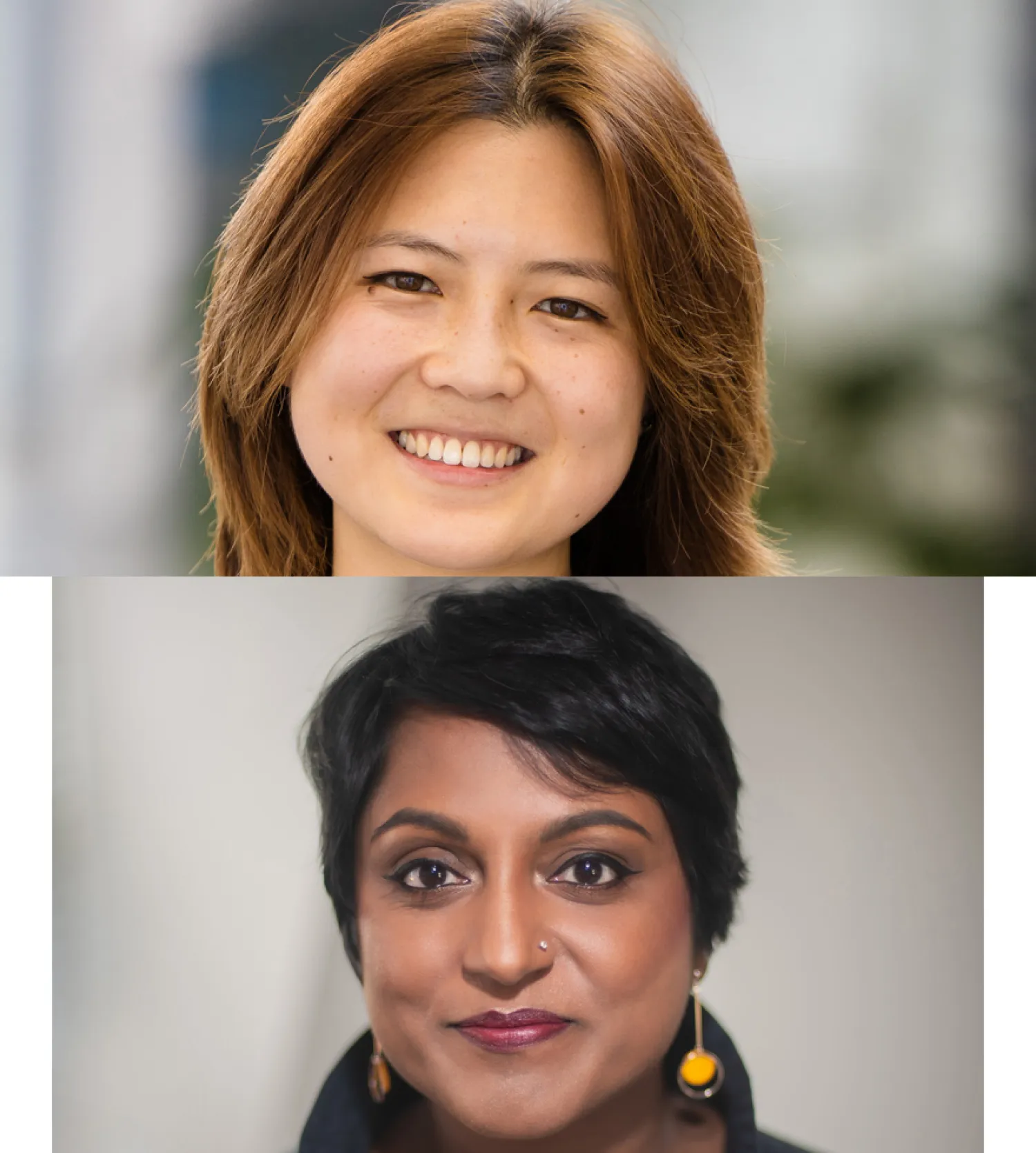
How would you describe the collaborative aspect of your student/supervisor relationship?
Deanndre: My collaboration with my supervisor is one that supports my general development as a thinker, even as it is focused on my research project. For example, when I engage with specific ideas in the literature I draw on for my project, Meera has encouraged me to take seriously the ideas of others, even if I do not agree with them. I believe this has made me a better interlocuter overall, and I find myself able to support fellow students in developing their ideas. It has also pushed my communication skills into a more sophisticated direction. I can communicate with others in a way that meets their baseline assumptions of how the world worlds, while still being true to how I see world politics. This is a useful skill in a department, where there is a range of political alignments and foci, but also in communicating my research to a range of audiences.
I also see my collaboration with my supervisor as one where we co-collaborators and both, in different ways, learning. I find this refreshing because it dispels the preconception I had in my head of needing to have an answer immediately to the questions I was asking. DPhil students, like me, sit between the spaces of becoming a specialist in our topic and producing our own knowledge on it, while also very much still in the process of learning and consuming knowledge along the way. The co-collaborating aspect of my relationship with my supervisor – where I am an equal and my ideas are taken seriously, even if they need to be developed further – has been supportive of my journey in navigating the ‘student/specialist’ balance. Meera has offered me the guidance to develop my ideas as well as the patience and space as I figure out what I want my research project to contribute to the field of IR. This was evident in my work on my thesis, and in other collaborations. Meera brought me on to work with her on a chapter for the forthcoming book, The Modern World After Colonialism Remaking the Social Sciences, edited by Gurminder K Bhambra, Ipek Demir, Paul Robert Gilbert, Su-Ming Khoo and Lucy Mayblin. Throughout the process, Meera asked me for my input, and we developed some of the key ideas of the book together. This was an important first step for me in understanding the process of publishing and developing myself as a career researcher.
Meera: I took Deanndre on as a research student not just because she was an excellent candidate, but because I found her research topic of food sovereignty so exciting and I was delighted to have the chance to learn more about it through our supervision relationship. We do a lot of thinking together in the supervisions, and because Deanndre is also intervening in my research area it is a very productive collaboration. We have also written together for a textbook recently, which was a great experience.
What impact does your student–supervisor collaboration have on your academic voice as a scholar or researcher?
Deanndre: My research project looks at the struggles of food sovereignty movements to redefine agricultural systems, and how that offers new insights, more broadly, for existing ideas in the critical perspectives on international relations. Through working with my supervisor to develop my project, I have learnt to trust my voice and believe that my ideas can contribute to the broader theoretical debates in international relations. It has also taught me to be more curious with regards to the range of ideas in critical approaches to the international, and to sharpen my arguments so that they recognise the spirits of the existing literature, even as they aim to go beyond them.
Meera: In working with Deanndre and other students over the years, I have become more appreciative of how knowledge is produced in relationships and networks as much as ‘by individuals’. Reading books and scholarship is also a kind of communing with people from different times and places, and when you talk to them you get to exchange those ideas directly. I think my scholarly voice is now much more shaped by the idea of writing as a form of communication with different audiences with different interests in what you might say.
In what ways do you co create knowledge, ideas, or innovations?
Deanndre: My supervisor and I share an interest in theorising the International from a critical perspective. It has been enriching to explore what insights of world politics we would generate from shifting the locus of analysis to the margins. In other words, what does world politics look like from the perspectives that are not that of Great powers, or even states? How might we theorise world politics from the ‘bottom up’? We have been exploring these questions, and I think we bring this focus into our conversations together, that we then take into our separate work.
Meera: I think every conversation we have is one in which we are co-creating ideas and work, and whilst these are naturally focused on Deanndre’s research project, they are also touching on big issues that resonate across lots of different areas of interest.
What have you learned from each other through working together – could you describe this in three words?
Deanndre: Knowledge is collectively produced. I know that is not quite three words, but it captures an important aspect of academia that I did not underappreciate before I started my PhD and had the working relationship I have with my supervisor. Through the conversations that my supervisor and I had in our meeting about my project, and in how I developed my skills at being an interlocuter, it became clear to me how often I was thinking with others as I developed my project. There have been many days when I have had conversations with my peers over lunch or spoken to my supervisor and those conversations would create a breakthrough in my thinking. But what was most surprising, and exciting, to me was the breakthroughs I would also have as just an observer to the conversations of others, such as when I listened to my supervisor and classmates comment on the research of others in the department-led IR Research Colloquium or the student-led seminar on critical thought, Sovereignty And Its Discontents (SAID). This osmosis-like and non-linear way I have learnt from and with my supervisor and classmates really underlined how much of a collective endeavour it is to produce knowledge.
Meera: If in doubt, think from the bottom-up!
Looking to the future - what are you excited to explore, or achieve next — together or individually?
Deanndre: Critical approaches in international relations are a vibrant space of ideas, particularly in Marxist and Postcolonial approaches. There seems to be a new wave of thinking that wants to push the space in new directions, beyond the central themes and parameters that shape these approaches. Critical approaches are attentive to the need to meet the urgency of our current moment of multiple and interlocking crises but recognise that a deeper systemic shift is required to meet these challenges. Theorising ways to address the slow(er) violences that are at play in the increasing instability of our current way of living and its impacts on care, community, and the natural world, while also being more responsive to the immediate violences of people in the current moment seems to be a big question animating scholars, and I am excited to see how my supervisor and I engage with this question together and in our respective research.
Meera: I really appreciate the very original perspective that Deanndre’s project brings to the world of critical theorising in IR – it asks in a fundamental way whether we start in the right place, and what it means to begin with people that are already involved in movements for change. I hope to think more with this perspective in framing my work on debt and indebtedness.
What hopes do you have for future generations of women scholars at DPIR?
Deanndre: I hope that women scholars at DPIR own their ideas pursue them in the most ambitious way that they can, and that the department is supportive of that, whether in the community it fosters, or in the supervisors guiding them.
Meera: I hope that women scholars (and staff) feel they move in an environment where they can be themselves and dream big about what scholarship can look like, in a supportive and mutually engaged community.
Find out more about Deanndre and Meera.