

The Cyril Foster Lecture 2026
Over the past 50 years, the Cyril Foster Lecture series has delivered engaging lectures from some of the world's most influential policymakers and academics. This year's lecture will be given by Samuel Moyn, the Kent Professor of Law and History at Yale University, where he also serves as head of Grace Hopper College.
Location: Examination Schools (High Street, Oxford OX1 4BG)
Date: Thursday 7 May 2026
Time: 5pm (6.30pm drinks reception)
War, Law, and a World in Crisis: An interview with Professor Samuel Moyn

Read our exclusive interview with Professor Samuel Moyn ahead of the 2026 Cyril Foster Lecture.
About this year's lecture
‘Gaza, the Humanisation of War, and the Politics of International Law’
Law is not just a set of rules to comply with (or not), but a terrain of political struggle. As the war in Gaza began 2023, leading politicians, international lawyers, and ordinary people engaged on that terrain, to advance strategy and honor principle. This lecture considers how the demand for war to be fought within humane limits has shaped how activists, observers, and politicians argue in the present and imagine the future. Does Gaza change whether we should regard international law mainly as a tool of the strong or a weapon of the weak?
About Samuel Moyn
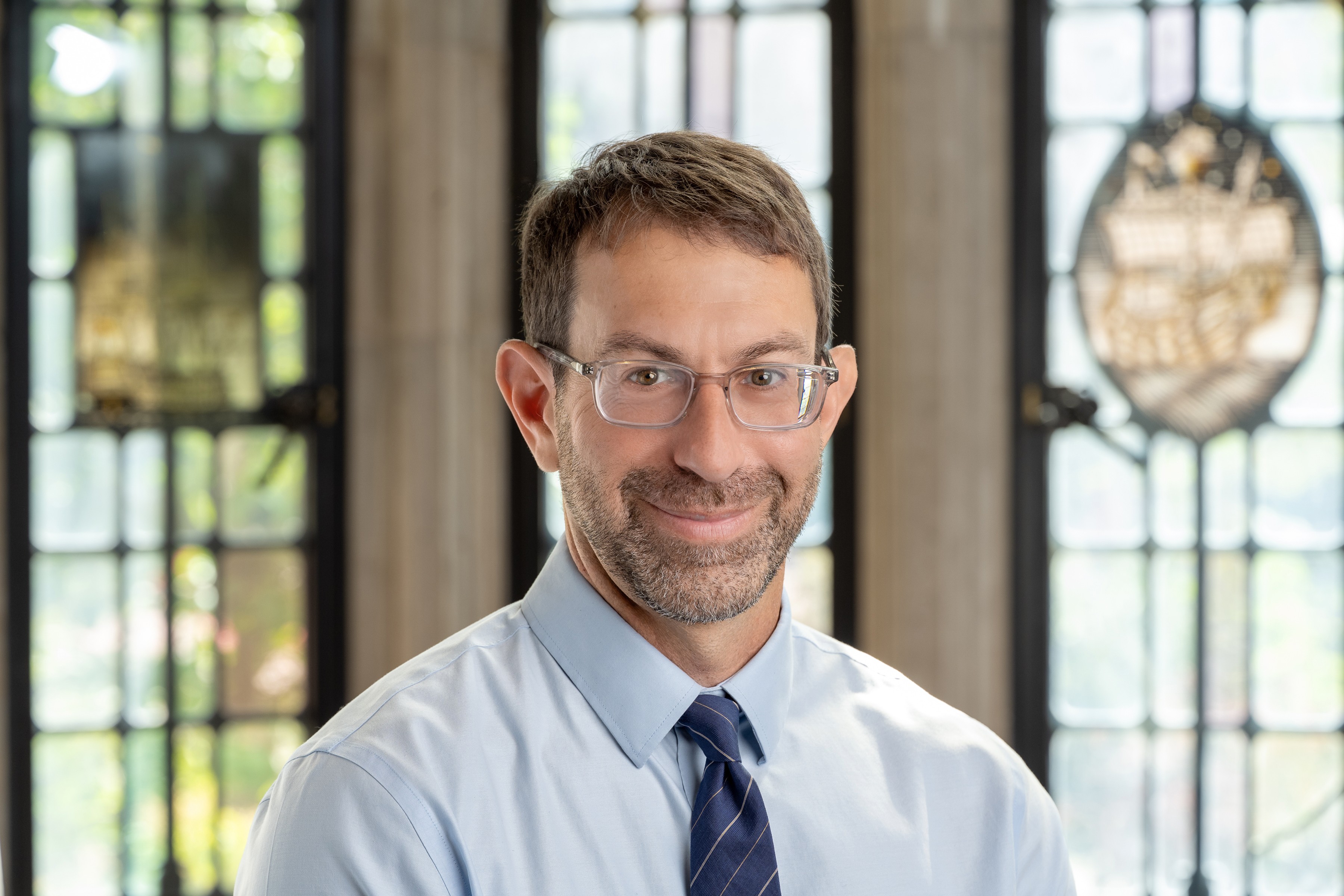 Samuel Moyn is the Kent Professor of Law and History at Yale University, where he also serves as head of Grace Hopper College.
His forthcoming book is Gerontocracy in America: How the Old Hoard Power and Wealth — and What to Do About It, scheduled to appear from Farrar, Straus and Giroux in June 2026.
Trained in modern European intellectual history, he works on political and legal thought in modern times and on constitutional and international law in historical and current perspective. His most recent book is Liberalism against Itself: Cold War Intellectuals and the Making of Our Times (Yale University Press, 2023), based on the Carlyle Lectures in the History of Political Thought at the University of Oxford.
He spent a decade writing some books about the history of international law and human rights, The Last Utopia: Human Rights in History (Harvard University Press, 2010); Christian Human Rights (Penn Press, 2015), based on Mellon Distinguished Lectures at the University of Pennsylvania in fall 2014; Not Enough: Human Rights in an Unequal World (Harvard, 2018); and Humane: How the United States Abandoned Peace and Reinvented War, (Farrar, Straus & Giroux, 2021), which came out in a paperback edition in 2022 with Picador in the United States and Verso in the United Kingdom.
Currently he is working on (different) projects constitutionalism and democracy, legal theory, and the Vietnam war.
Moyn is a fellow of the Quincy Institute for Responsible Statecraft. Over the years he has written in venues such as the Atlantic, Boston Review, the Chronicle of Higher Education, Commonwealth, Dissent, the Guardian, the London Review of Books, The Nation, The New Republic, the New York Times, the Wall Street Journal, and the Washington Post.
Event Schedule:
4.30pm - 4.55pm: Registration
5pm prompt: The Cyril Foster Lecture 2026 will start;
- Opening remarks from Pro-Vice-Chancellor
- Introduction to Samuel Moyn by Edward Keene
- Cyril Foster Lecture 2026: ‘Gaza, the Humanisation of War, and the Politics of International Law’
- Q&A chaired by Edward Keene
- Closing remarks by Head of Department of Politics and International Relations, Professor David Doyle
6.30pm - 7.30pm: Drinks Reception
Register online for the Cyril Foster Lecture 2026.
About the Cyril Foster Lecture Series:
See the full list of past lectures
This lecture series is the legacy of Cyril A Foster. We know very little about him. Mr Foster owned several small sweet shops in and around London and lived alone in Essex. On his death, he left a bequest to the University, asking us to create an annual lecture series on the ‘elimination of war and the better understanding of the nations of the world’. This wish is particularly unusual, as he had no previous connection to the University. His kind and generous gift continues to promote international cooperation.
Previous speakers include prominent figures from the world of politics and policy, from prime ministers and foreign ministers, to secretary-generals of the United Nations and heads of major international organisations, as well as prominent academics.