

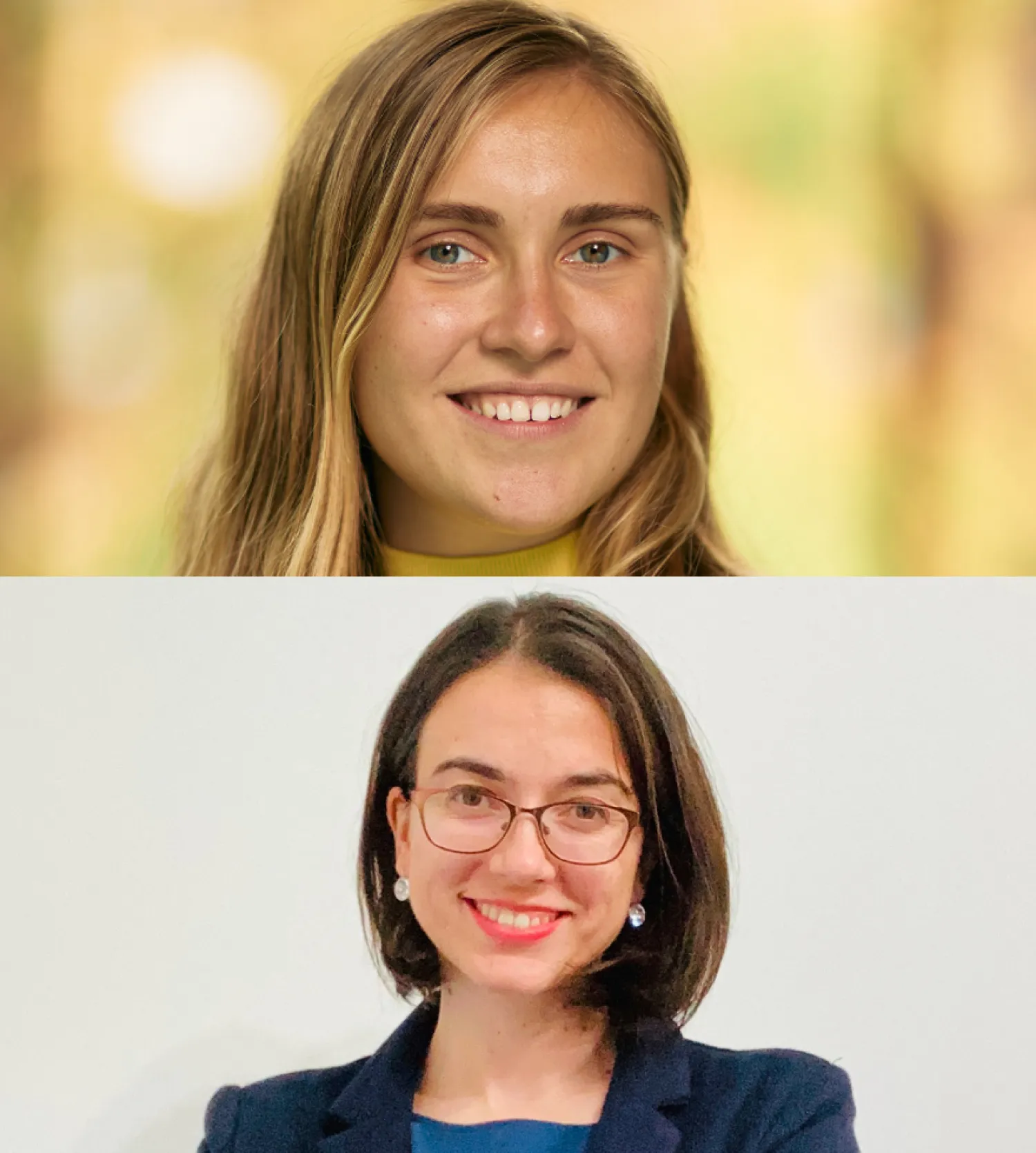
How would you describe the collaborative aspect of your student/supervisor relationship?
Ekaterina: I would describe the collaborative aspect of our relationship as inspiring. It is inspiring in the sense that it allows me to grow both as a researcher, but also as a student who is trying to navigate academia and the DPhil. Katerina not only gives me space but also encourages me to develop my ideas and to voice them, while also guiding me into the most fruitful directions. I feel like the encouragement of active thinking and of voicing is particularly important in the case of female students.
Additionally, I really value in our relationship that Katerina sees her students not just as academics, but as people who sometimes might just need some support. It really helps to have that human side in the student/supervisor relationship.
Katerina: Our relationship with Ekaterina is grounded in intellectual partnership. While my role is to provide guidance and feedback, the most rewarding aspects of our work together have been genuinely collaborative. I am particularly proud of the many moments in which Ekaterina has asserted her intellectual contribution, defending her arguments with clarity, and presenting her work internationally with authority and confidence. I am equally proud of the kind colleague she is. She consistently offers thoughtful and constructive feedback in departmental seminars and group supervision meetings, contributing to a culture of generosity and rigour.
What impact does your student–supervisor collaboration have on your academic voice as a scholar or researcher?
Ekaterina: It has an invaluable impact, since it basically forms my academic voice as a scholar and researcher. As a woman, I believe that having a female supervisor really allows you to have a role model that you can follow. This, in turn, allows you to gain confidence not only in your own skills, but also in the fact that you belong in academia. Ultimately, I am sure that I would not be able to be such a confident scholar and researcher if it wasn’t for our student–supervisor collaboration.
Katerina: Working closely with Ekaterina has sharpened my own thinking. She brings a fresh and rigorous perspective to theoretical debates, often pushing conversations in new and productive directions. Our supervision meetings require me to clarify assumptions, refine concepts, and stay attentive to emerging methods and cutting-edge scholarship.
This collaboration reinforces, for me, the importance of modelling clarity, intellectual generosity, and collegiality. Supervision is not only about guiding research, but also about embodying the scholarly values we hope to sustain within the discipline.
In what ways do you co create knowledge, ideas, or innovations?
Ekaterina: As previously said, Katerina always encourages her students to think and to contribute with their own ideas. This holds not only in the case of the students’ theses, but also during other scholars’ presentations, and during work for her as research assistants. I believe that this environment ultimately helps generate much more knowledge, ideas, and innovations. With this type of encouragement, I have noticed that I started thinking much more creatively about the field of political science, both when working on my thesis, and when engaging with other scholars’ work.
Katerina: We co-create knowledge through sustained dialogue and exchange. In supervision meetings, we develop ideas iteratively, reframing arguments, refining concepts, and deepening our engagement with both theoretical and empirical challenges. Our collaboration also extends beyond the thesis itself, as we work together on related research projects. The most meaningful contributions emerge from thoughtful, cumulative exchanges over time.
What have you learned from each other through working together?
Ekaterina: I have definitely learnt to be curious, to always push myself, but to also take more time for myself and my family. Katerina encourages me to always think of interesting questions, to look for answers, and to never give up (even when things seem tough). Alongside her encouragement to work hard, she also strongly insists on the fact that it is important to take time off. In an overachieving environment I am grateful to my supervisor for promoting a healthy work-life balance.
Katerina: Ekaterina’s resilience, persistence, and commitment to excellence have been both energising and inspiring. Her intellectual ambition is matched by her generosity as a colleague. In turn, I try to offer a structured approach to research, careful attention to theory and research design, and, just as importantly, perspective during moments of uncertainty.
If I were to summarise our working relationship in three words, I would choose: kind, rigorous, and ambitious.
Looking to the future - what are you excited to explore, or achieve next — together or individually?
Ekaterina: In the future I am excited to work more with Katerina. Both on research projects together, as well as on my DPhil thesis as her supervisee. Her work and research are fascinating. I am ultimately excited to take what I have learnt from her, and to apply it in future jobs as a scholar while building my own research.
Katerina: Looking ahead, I am excited to see Ekaterina’s research reach its full potential and receive the recognition it deserves, through presentations, publications, and public engagement. I have no doubt that Ekaterina will thrive across research and teaching, contributing to the fields of authoritarian politics, political communication, and public opinion.
What hopes do you have for future generations of women scholars at DPIR?
Ekaterina: I hope that they can also have role models that show them that women belong in academia. I truly feel lucky to have a supervisor who can help me overcome all the stereotypes and social pressures that we, as women, are used to. Seeing how another woman has overcome all the difficulties of academia and has become a prominent scholar really paves the way for future generations of women.
Katerina: I hope future generations of women scholars at DPIR feel supported and fully recognised as intellectual leaders. Above all, I hope they never feel that they are entering a space not designed for them. It matters that women scholars see themselves reflected in seminars, in research, and in leadership positions.
I have myself been fortunate to benefit from outstanding women mentors who combined academic rigour with kindness, including Catherine de Vries, Tomila Lankina, and Kristin Bakke. I hope to pay that forward, and I know that Ekaterina will do the same.
Find out more about Katerina and Ekaterina.