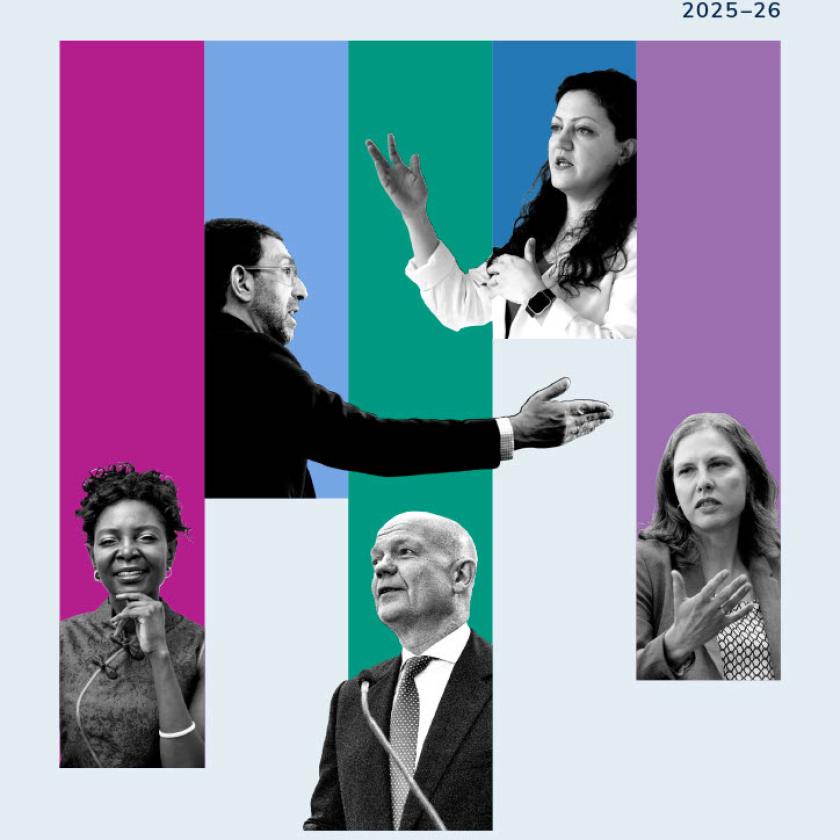

Geopolitical Risk Programme, July 2026







The Department of Politics and International Relations welcomed senior leaders from across sectors to Rhodes House from 16–18 July 2026 for the second edition of its Executive Education programme, Geopolitical Risk.
Designed to help decision-makers navigate an increasingly complex and uncertain international environment, the three-day programme combined cutting-edge academic expertise with practical insights for assessing and responding to geopolitical challenges.
The programme opened with a formal dinner at Rhodes House, featuring remarks from Programme Director Professor David Doyle and a keynote address from Professor Jane Green, Professor of Political Science and British Politics.
Exploring Today's Geopolitical Challenges
The second day brought together leading Oxford academics to examine some of the most pressing sources of geopolitical risk facing organisations today.
Participants heard from:
- Professor Todd Hall on Political Risk in China
- Professor Maryam Alemzadeh on Military Structure in Iran: Implications for Geopolitical Risk Assessment
- Professor Lucas Kello on AI and Cyber Risk in a Fragmenting World
- Professor Desmond King & Dr Ursula Hackett on The Uncertainty of US Politics
Alongside the academic sessions, attendees had the opportunity to continue discussions over dinner at Rhodes House and a guided walking tour of Oxford's historic city centre.
Turning Analysis into Action
The programme concluded with a practical session focused on implementation and organisational resilience. Led by Neil Unsworth OBE, Director, Oxford Leadership and Character Programme, the workshop explored how leaders can apply geopolitical insights within their own organisations, equipping participants with tools and frameworks for real-world decision-making. Through a practical planning exercise, participants explored how timely and effective implementation can strengthen organisational resilience and create a competitive edge in a rapidly evolving geopolitical landscape.
Building on these themes, the Industry Perspectives Panel Discussion brought together experienced practitioners to examine how organisations are responding to geopolitical uncertainty in practice. Panellists shared insights into how they monitor and assess geopolitical risk, strengthen organisational resilience, and embed geopolitical considerations into strategic decision-making across sectors.
Strong Early Feedback
Early feedback highlighted the programme's combination of academic rigour, practical relevance, and opportunities for meaningful discussion with an international cohort of peers.
Participants praised the calibre of the faculty and the breadth of topics covered, with many describing the sessions as both thought-provoking and immediately relevant to their professional roles. Discussions on AI and cyber risk proved particularly popular, with attendees noting the value of exploring emerging technologies through a geopolitical lens.
Several participants also emphasised the unique opportunity to engage with senior professionals from a wide range of sectors, countries, and backgrounds. The diversity of perspectives, combined with ample opportunities for interaction with faculty, was frequently cited as one of the programme's greatest strengths.
Attendees highlighted the final implementation workshop as an especially valuable component of the programme, providing practical frameworks and tools to translate geopolitical analysis into organisational decision-making and resilience planning.
One participant described the programme as "a valuable investment for anyone seeking to strengthen their strategic understanding of geopolitics and make better-informed decisions in an increasingly complex world," while another noted that it provided "a rare opportunity to exchange ideas with a diverse group of professionals from across the public and private sectors on some of the most important global challenges of our time."
Others reflected on the broader significance of the programme, observing that geopolitical risk has become a core leadership concern affecting everything from investment decisions and supply chains to technology strategy and organisational resilience. Participants left with not only new analytical frameworks and insights, but also a network of peers and contacts that will continue to inform their work long after the programme concluded.
Looking Ahead
Expressions of interest are now open for the next iteration of the programme, taking place 27–29 May 2027.
Complete the expression of interest form.