
Life After DPIR: Meet Katie Tyner – DPhil alumna, MSc Politics Research, 2019

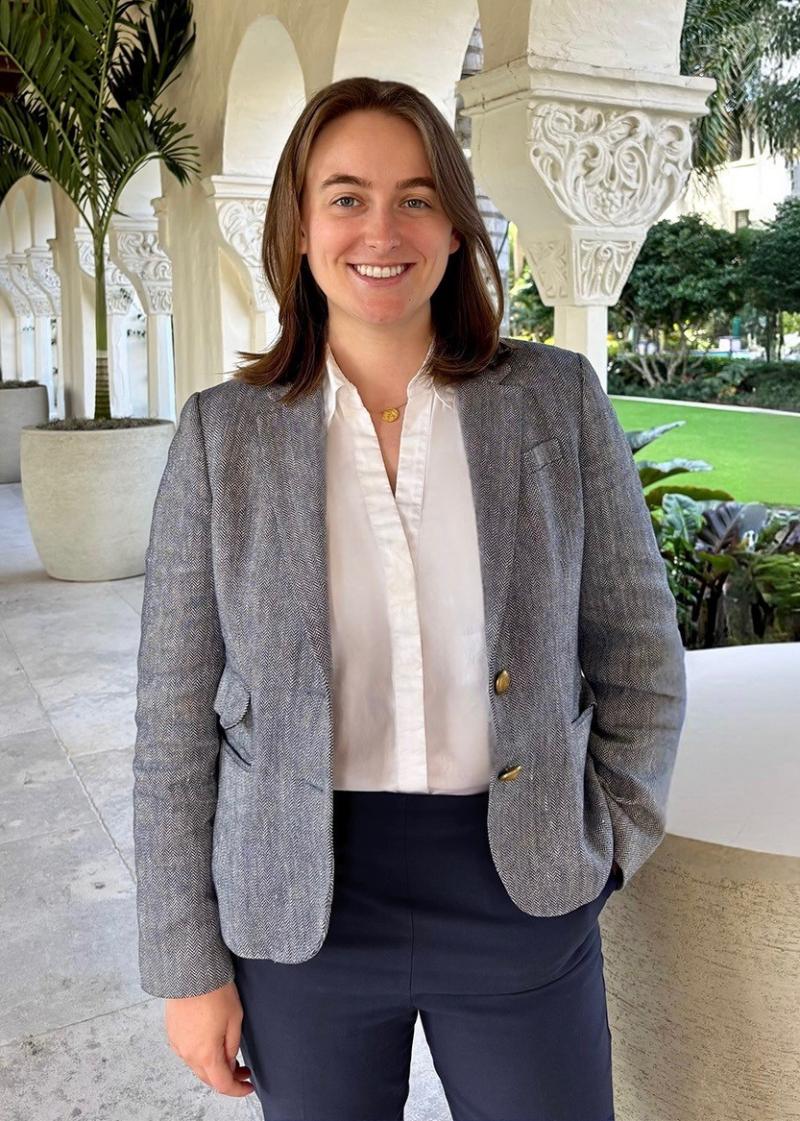
Katie Tyner, who completed the MSc in Politics Research at DPIR with a focus on comparative politics, is now Associate Vice President at The Cohen Group in Washington DC. There, she leads major client accounts across the technology and national security sectors, helping organisations navigate government engagement, long term business development, geopolitical risk, and global market strategy.
We recently caught up with Katie to hear her reflections on her time in Oxford, and how those experiences continue to shape her career.
Oxford is the most wonderful intellectual playground. I found the whole city to be teeming with excitement and energy, even on the cloudiest days. Balliol and the DPIR served as really grounding anchors in shaping my sense of community at the University and my network of friends, colleagues, and mentors – some of my closest friendships today were formed at Oxford! I think it goes without saying that Balliol and DPIR are both hubs for academic vibrancy, but what I appreciated even more was how both institutions embody what philosopher Ludwik Fleck describes as a “thought collective,” where cognition is a communal activity. My peers and I weren’t doing our work in silos – we were sharing ideas across disciplines over dinner in the Balliol dining hall, debating theoretical approaches during the Nuffield political science seminar, and supporting each other through successes and challenges. It was the best.
How important were your studies in Oxford in laying the foundation for your career?
When I look back on my academic career, it’s clear to me that my parents taught me how to learn, my high school (Miss Porter’s School) taught me how to study, my undergraduate university (Wesleyan University – College of Social Studies) taught me how to create, and in many ways I think my graduate studies at Oxford brought me back to basics in teaching me how to understand. There’s that famous quote from Albert Einstein, “The more I learn, the more I realize how much I don’t know.” I remember in one of my first tutorial papers I developed a critique of an existing theory and I was excited to show up to tutorial discussion and dive into that critique. I’ll never forget when my professor for that tutorial, Ezequiel González Ocantos, politely course-corrected me with the guidance to spend as much time as I can understanding the theory itself, from all angles – its underpinnings and assumptions, its core components, the building blocks that comprise it – before jumping to the critique. I thought I had done that, but looking back, I hadn’t given the “understanding” phase enough time. The critique is important, but impossible without sufficient understanding. I think this is a lesson that transcends academia and has been very useful to me in my daily work in Washington.
What impact did studying politics have on your current role at the Cohen Group in Washington?
To study comparative politics is to study history. I enjoy grounding myself in knowing that anything that unfolds on the global stage today likely has roots in something that has happened before at some point in time, in some part of the world. We need to learn from the past to fully understand the present. At The Cohen Group, we advise clients on how to make sense of the ever-changing geopolitical landscape, and how the products or solutions they have developed can serve to address many of the most pressing challenges facing us today. My training at DPIR has been integral to my work in helping “make sense” of the world around us. On a practical level, I also really appreciated the quantitative training I received in the DPIR (even though I didn’t always appreciate it during long nights in the library tracking down the error in my code!). Having training in regression analysis, machine learning, and other quantitative techniques has been useful for my understanding of our clients that are on the cutting edge of tech and AI.
Can you tell us a little more about your work and what you do?
In the classroom, we are often taught that a country’s national security posture and/or the dynamic relations between countries are both primarily dictated by policies set by governments and actions taken by the State Department / Ministry of Foreign Affairs. While there is certainly truth to this, I think there is a lack of appreciation for the roles that industry and defense departments/ministries play in shaping our geopolitical realities; I never fully understood this until working at The Cohen Group, a strategic advisory firm founded in 2001 by former U.S. Secretary of Defense William Cohen with the objective of helping multinational clients understand complicated political, regulatory, and economic landscapes around the world. My colleagues at The Cohen Group bring with them deep knowledge and expertise from the public sector, in many cases following decades of public service. I lead client accounts in the technology and national security sectors and co-lead the firm’s defense practice, supporting clients to develop government engagement strategies, pursue long-term business development and capture, mitigate geopolitical risk, and manage market entry and exit. Commercial diplomacy is particularly critical right now given the state of transatlantic relations and the Trump Administration’s posture towards Europe. Oftentimes it is the stability of commercial ties between partners in industry that can keep boats steady when political headwinds change in rough and unpredictable ways.
Your study based on your DPIR dissertation was recently published in Comparative Political Studies. Do you hope it will lead to further academic research?
I love keeping my academic research alive even though I’m no longer affiliated with an academic institution. My DPIR dissertation, which began as my Wesleyan undergraduate thesis, has been my passion project for many years, and I have several mentors to thank for encouraging me to not let go of my dream to publish that project. Sarah Wiliarty, Don Moon, and Cecilia Miller from Wesleyan were all integral in that journey, as were countless DPIR professors and staff, including Ezequiel González Ocantos, David Rueda, Petra Schleiter, Nicholas Owen, Daniel Butt, Andrew Eggers, Spyros Kosmidis, Desmond King, and others. Being part of the DPIR community inspired me to aim high with where I submitted my paper, and I feel grateful that it landed at CPS. I think academic research is all about contributing to a larger dialogue, inviting critique, and hopefully ultimately building something bigger together. My education at the DPIR enabled me to elevate my work to the next level, even after graduating from Oxford, because I was trained in the principles of theory-building and nuanced methodology.
This work looked at comparative political leadership styles of women – what was the motivation behind this research, and what does it tell us about varying styles?
The primary inspiration for my research back in 2018 was the observation that several female political leaders, regardless of country or decade, have been labelled the “Iron Lady” of her country or region. This began as a small observation at first and grew into the larger discovery that there has been a well-documented pattern in which women leaders are often constrained by expectations to demonstrate proof of masculinity to be considered effective. Despite the fact that the number of women leaders has nearly tripled in the past two decades, the majority of the canonical texts on political leadership focus solely on case studies of male leaders. And so I had a question that I really wanted answered: is it possible for those expectations that govern women leaders to change over time? If so, how do they change and why? Those are the questions at the heart of my study in CPS. The study has gone through many, many iterations since 2018, but the core questions have driven my passion the whole time.
What are your future aspirations?
I certainly plan to stay active in academic circles, my academic passions make me feel alive. I will be presenting my research at the 2026 conference hosted by the Council for European Studies (the 32nd International Conference of Europeanists) in Dublin this June. I’m not sure what academic project is next in store for me, but I’m excited to find a research question that I need to answer so badly that I’ll spend years dedicated to it. My areas of interest include democratic decay (unfortunately no shortage of case studies), the role of language in political outcomes, women in politics, the interplay between a country’s defence apparatus and civilian political leadership, and the role that the private sector plays in shaping our geopolitical realities. In terms of my day job, I love working at The Cohen Group and plan to continue growing and learning at the firm. Ultimately, I enjoy bridging the two worlds (academic theory and “hands-on” practice).
Finally, what message can you give to future researchers and students applying to study politics at Oxford?
Having an understanding and appreciation for both theory and practice will serve you well in your career, whether that be in academia, government, the think tank space, the private sector, or something else altogether – your career can even include all of the above. The most important thing is to find a professional community where you feel both challenged and valued – that is a rare mix, and if you find it, hold on to it! Take advantage of everything Oxford has to offer and don’t be afraid to admit when you don’t know the answer, you will end up better for it.