

Image: VRVIRUS / Shutterstock
OCPSG is committed to training people who are able to harness the benefits of AI and computational methods meaningfully to answer important socio-political and policy questions. This dual understanding of both the political/social science and the computational sides is important in encouraging the correct examination or application of these methods and informing better integration of new technologies into research or the broader society: Grounding the computational models in theory and socio-political contexts allows more logical and comprehensive answers to social challenges, whereas mastering the use of advanced algorithms enables more appropriate and scalable testing of hypotheses using such techniques. Together, they will enable more robust answers to important questions that were neglected or not solvable before.
As the flagship programme of OCPSG, our Research Programme works on replications of existing research, visualizations of key political science topics, critiques of methodologies or computational method applications of existing research, and also original evidence-based research projects. We also run separate internal projects besides the Research Programme on topics related to the applications of computational methods, including large language models.
Our recent major focus is on the intersection between political science or policy and AI safety/risks (e.g. risks due to misinformation and disinformation) or the application of AI and other natural language processing methods in benefitting research on critical problems (e.g. applying NLP methods to study discrimination in legislation, applying machine learning algorithms to study wildfire activities and climate opinion, studying LLM applications in collective deliberation and decision-making).
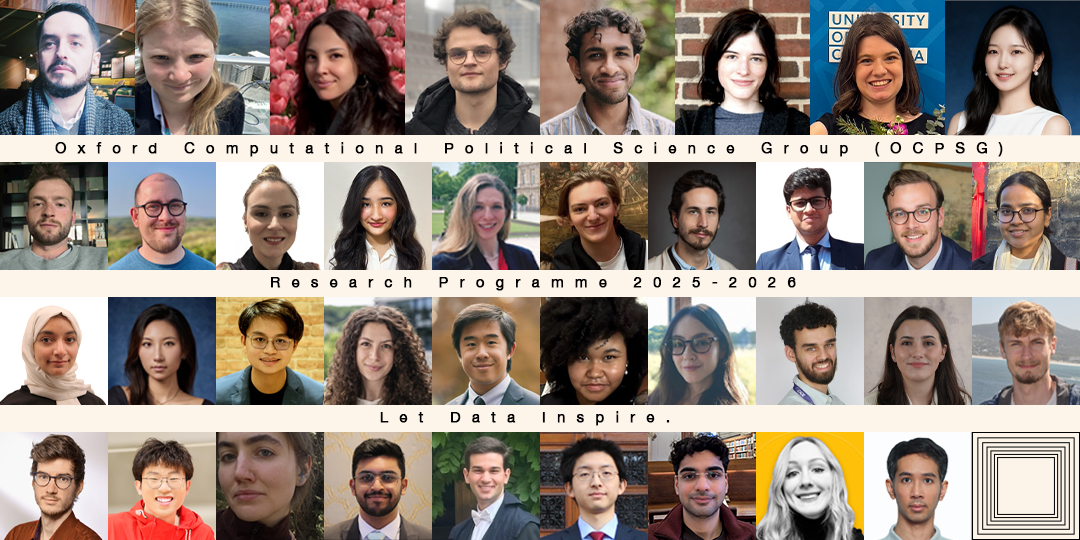
Our Research Programme features young professionals, researchers, PhD graduates, graduate students, and undergraduate students affiliated with Oxford or other leading universities all over the world. Our members also have working or advisory experience in government agencies and major organizations like the UN, the UNDP, the UNEP, the ILO, the Center for AI and Digital Policy (CAIDP), POLITICO, and NVIDIA.
Projects
Current Projects
Benchmarking LLMs and Fine-Tuned Models for Multilingual Policy Agenda Annotation in European Parliamentary Speeches (Bastián González-Bustamante)
- Led by Bastián González-Bustamante (Leiden), this project focuses on benchmarking zero-, few-shot and reasoning LLMs’ capabilities against fine-tuned Transformer baselines for multilingual policy agenda annotation using European parliamentary speeches as the core corpus. It aims to construct a reproducible evaluation pipeline that compares open and closed LLMs with fine-tuned BERT-family models across multiple European languages, quantifying trade-offs in performance, robustness, computational costs, and carbon footprint.
- For more details about this project, please visit its project website.
Using NLP and Sentiment Analysis to Evaluate the Interplay Between EU/UK Migration Law and Religious Anti-Discrimination Law (Daria Godorozha and Sara Gabrielli)
- Led by Daria Godorozha (LSE) and Sara Gabrielli (LSE), this project focuses on applying natural language processing (NLP) and sentiment analysis to examine how Migration Law affects and intersects with religious Anti-Discrimination Law across the EU and UK, both in theory and in practice.
Analysing the Effects of Wildfire Activity on Climate Opinion in the US (Stephan Wenninger)
- Led by Stephan Wenninger (LSE), this project focuses on examining the past and future effects of wildfire activity on climate opinion in the US at the county level. Besides employing statistical inference that allows for cross-sectional and time-sensitive heterogeneity, it also tests different machine learning algorithms to create a forecast of future changes in climate opinion.
Investigating Manosphere Community Structures Longitudinally Using Social Network Analysis (Ryan Ratnam)
- Led by Ryan Ratnam (Oxford / Penn State), this project focuses on examining the changing structures of Manosphere communities over a longitudinal period. It employs social network analysis to map Manosphere communities, utilizes survival analysis to predict how long users stay active and the probability of user migration, and leverages interrupted time-series analysis to infer the effects of offline events on the Manosphere’s structure.
Tracing Argument Evolution: A Text-as-Data Experiment in Collective Deliberation (Maria Milosh)
- Led by Maria Milosh (Chicago / MetaGov), this project focuses on investigating how exposure to others’ reasoning shapes preferences and collective decisions in large-scale online policy discussions. It also employs text analysis to identify policy and well-being arguments in transcripts of collective deliberations, trace their evolution, and measure how participants’ views shift once they engage with others’ perspectives.
Mapping Disinformation Networks and Democratic Trust in EU Member States (with Europinion)
- This joint collaboration with Europinion − Europinion Institute for Research (EIR) focuses on exploring how disinformation networks linked to Russian influence campaigns affect public trust and democratic resilience within the European Union. This project employs automated text analysis to examine how Russian disinformation efforts interact with domestic and European political narratives in EU democracies, shaping public trust and institutional resilience.
Multi-dimensional Bias in Modelling Multi-dimensional Preferences: Evaluating the Ability of Synthetic Agents to Replace Human Participants in Conjoint Experiments (Bosco Hung)
- Led by our Co-Founder and Director Bosco Hung, this internal project focuses on investigating whether synthetic LLM agents can reliably replace human participants in conjoint experiments. We address this gap by replicating published conjoint studies and systematically comparing the alignment of choice distributions and estimates generated by synthetic agents to original human data. The results presented lend themselves to analyzing whether synthetic agents could provide a credible benchmark for estimating the treatment effect in the case of conjoint experiments for exploring multi-dimensional preferences, thus providing a foundation for future scholars to diagnose or correct for related problems.
- Access the working paper.
Past Projects (2024-25)
Mapping Coercive Capacity Over Time (Thomas Brailey)
- Led by Thomas Brailey, this project focuses on developing a fine-grained geospatial measure of coercive state capacity. It combines geolocated survey data, geospatial data, and road data. Using this measure of military, police, and security apparatus reach, this project investigates the relationship between state capacity and various outcomes like attitudes toward violence and instances of private violence.
Measure Moral Contagion Effect in Online Environment (Calvin Cheng)
- Led by Calvin Cheng, this project focuses on addressing key gaps in current research on the moral contagion effect. It aims to test this effect within the context of online information diffusion. It focuses on developing automated methods to measure morality in textual data and investigating how moral content spreads and influences behavior on social media, using innovative causal research designs to account for confounding factors. Read the summary of their project output.
Mapping the Simplified Chinese Political Communication Landscape on Foreign Platforms (Zihao Zhang)
- Led by Zihao Zhang, this project focuses on mapping the political communication landscape in Simplified Chinese on foreign platforms. It focuses on discovering ideological categories in politics-related posts and classifying key opinion leaders (KOLs) based on their posting contents using natural language processing techniques and mapping the information networks of KOLs based on common followers using social network analysis.
Testimony from Our Past and Current Members
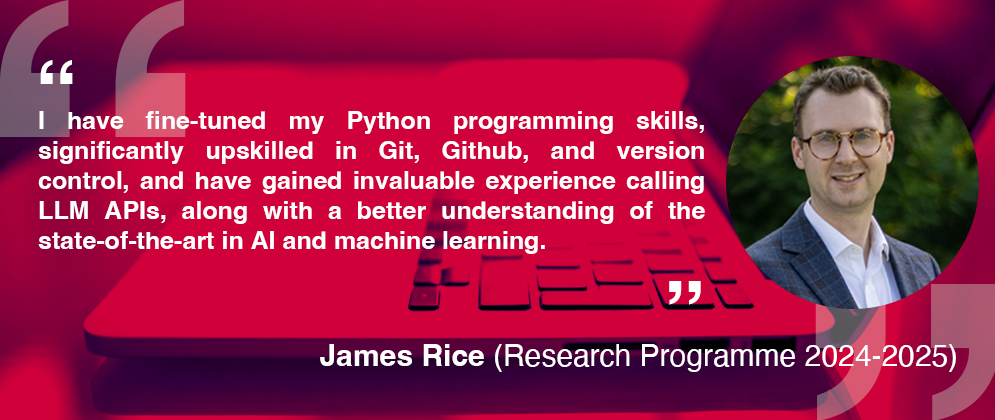
- ‘[I like] the lively and friendly environment, and chances to be connected with other researchers.’
- ‘What I liked most about the OCPSG Research Programme was the chance to work with a team and learn from others’
- ‘The OCPSG offers a golden opportunity for early-career scholars with limited resources to lead their own research projects from start to finish. It provides a supportive and friendly environment in which you can gain valuable experience managing computational social science research.’
- ‘The OCPSG Research Programme gave me an amazing opportunity to grow as a researcher. I especially enjoyed working with such a diverse group of people and learning from their unique perspectives. I would definitely recommend it to anyone interested in research.’
- ‘Being an OCPSG researcher offers a great opportunity for the participants to advance their skills, to network and collaborate with other bright interdisciplinary researchers on some of the most important research topics.’
- ‘I am very happy to be part of OCPSG. The information is clearly communicated with us and the environment is very collaborative.’
FAQs
Does OCPSG’s Research Programme only accept applications from students or researchers affiliated with Oxford?
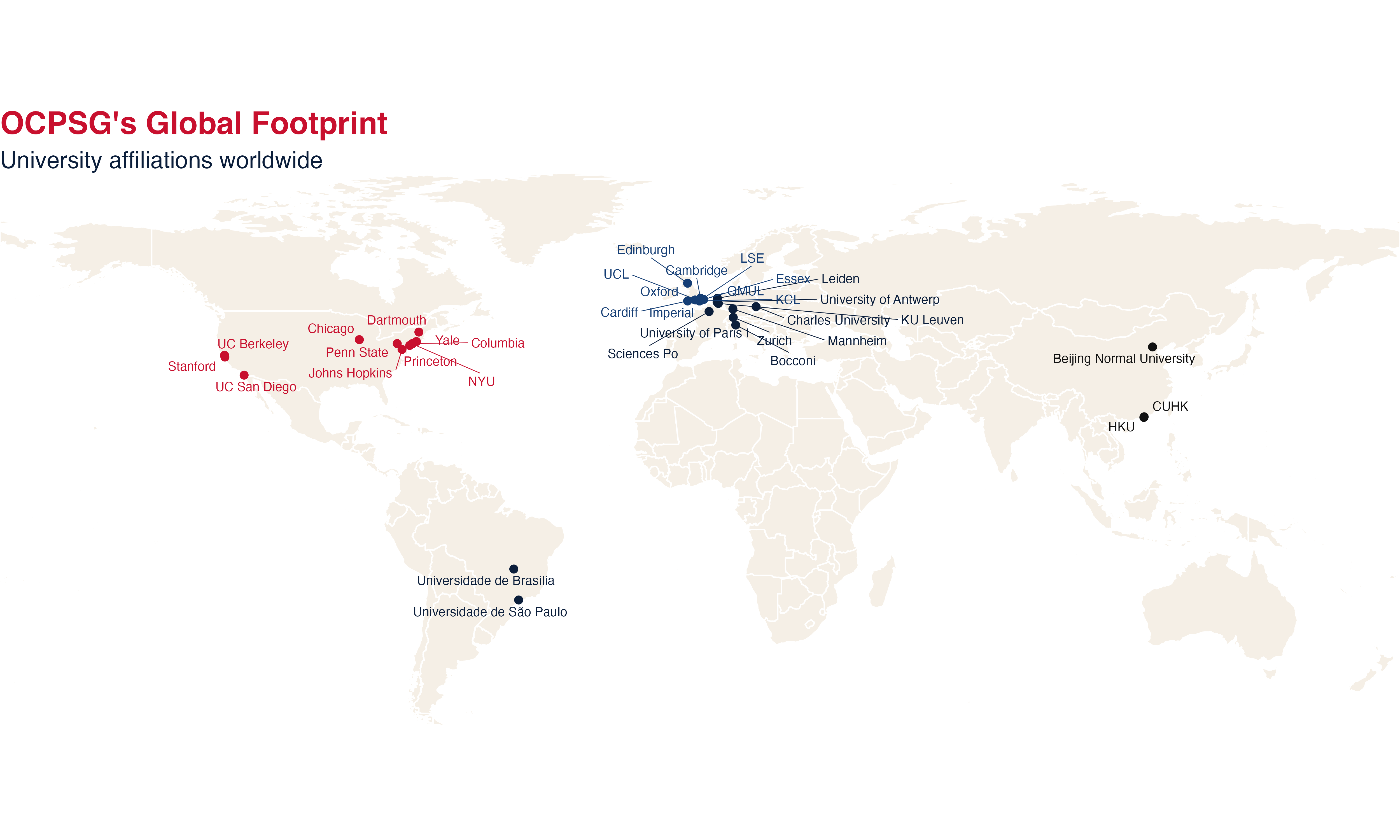
No, our Research Programme features members holding degrees from or currently studying at Oxford or in other leading universities all over the world, covering the UK (Cambridge, Imperial LSE, UCL, KCL, QMUL, Edinburgh, Cardiff, Essex), the US (Stanford, Princeton, Yale, Chicago, Johns Hopkins, Columbia, NYU, Dartmouth, UC Berkeley, UC San Diego, Penn State), Europe (Leiden, Sciences Po, University of Paris I: Panthéon-Sorbonne, University of Mannheim, University of Zurich, Bocconi, KU Leuven, University of Antwerp, Charles University), Latin America (Universidade de São Paulo, Universidade de Brasília), and Asia (CUHK, HKU, Beijing Normal University).
Do I have to be a current student to join OCPSG’s Research Programme?
No, our Research Programme features early and mid-career industry professionals, government and policy practitioners, researchers, PhD graduates, graduate students, and undergraduate students. We care more about the passion and ability of applicants rather than their seniority.
Do I need to have a political science background to join OCPSG’s Research Programme?
No, we welcome people with any background and value interdisciplinary collaboration. The backgrounds of our members range from political science to international relations, public policy, geography, law, public health, biology, history, Chinese studies, computer science, engineering, statistics, mathematics, sociology, philosophy, economics, data science, and medicine. Our members at Oxford also come from a diverse range of departments, including the Department of Politics and International Relations, Oxford Internet Institute, Oxford School of Global and Area Studies, School of Geography and the Environment, and the Mathematical Institute.
Do I need a machine learning or quantitative background to join OCPSG’s Research Programme?
No, we are committed to improving the accessibility of these technical elements for people from different backgrounds. Good execution of AI, machine learning, and other computational projects on policy or social science topics also requires a solid understanding of the theoretical or conceptual side. Thus, we value the perspectives of people not from a quantitative background. Our programme is open to people who are willing to learn more about the intersection between political science or policy and computational methods.
How competitive is the programme?
The programme is highly competitive. In the 2025/2026 cycle, roughly 10% of candidates applying to our Research Leader and Research Associate roles were selected. We received 273 applications from students and researchers across leading universities worldwide, as well as industrial professionals who are interested in joining as a Research Associate.
What is the expected time commitment?
We expect a time commitment of around 6-10 hours per week.
What is the difference between Research Leaders and Research Associates?
Research Leaders have to propose and develop their own research project. Responsible for project management, they have to lead a team of Research Associates. Together, everyone will contribute to every step of the research process, including but not limited to data collection, data analysis, literature reviews, theory development, and writing.
Could you give me some application tips?
- Show the originality and value of your project idea, and how it contributes to the field (for Research Leaders)
- Highlight how and why computational methods (e.g. network analysis, automated text analysis, simulations and computational modelling, neural networks, spatial methods, causal ML), can be applied, and their feasibility (for Research Leaders)
- Demonstrate your analytical, programming, interpersonal, and project management skills
- Tailor your CV to emphasise relevant experience and show how the skills you gained could be transferable
- Take time to proofread your application
- Don’t submit a purely LLM-generated response
Is the Research Programme a paid opportunity?
Due to limited funding sources, participants are typically unpaid and we also do not guarantee research grants for projects.
If you are interested in sponsoring our research activities, feel free to get in touch with us at ocpsg@politics.ox.ac.uk
Does OCPSG run projects outside the Research Programme?
We also run separate projects outside the Research Programme where we collaborate with Researchers based at Oxford or elsewhere. If you are interested in collaborating with us or any of our members, feel free to get in touch with us at ocpsg@politics.ox.ac.uk.
How do I know when the next round of application is open?
Join our mailing list by filling out this simple form to receive updates about research opportunities. Also, feel free to follow our Instagram and LinkedIn pages for more information.