
DPIR students urged to make a difference with UK tutoring charity founded by PPE alumna


As part of National Volunteering Week (1st – 8th June), DPIR students are being invited to volunteer one hour a week as tutors to support GCSE and A-level pupils.
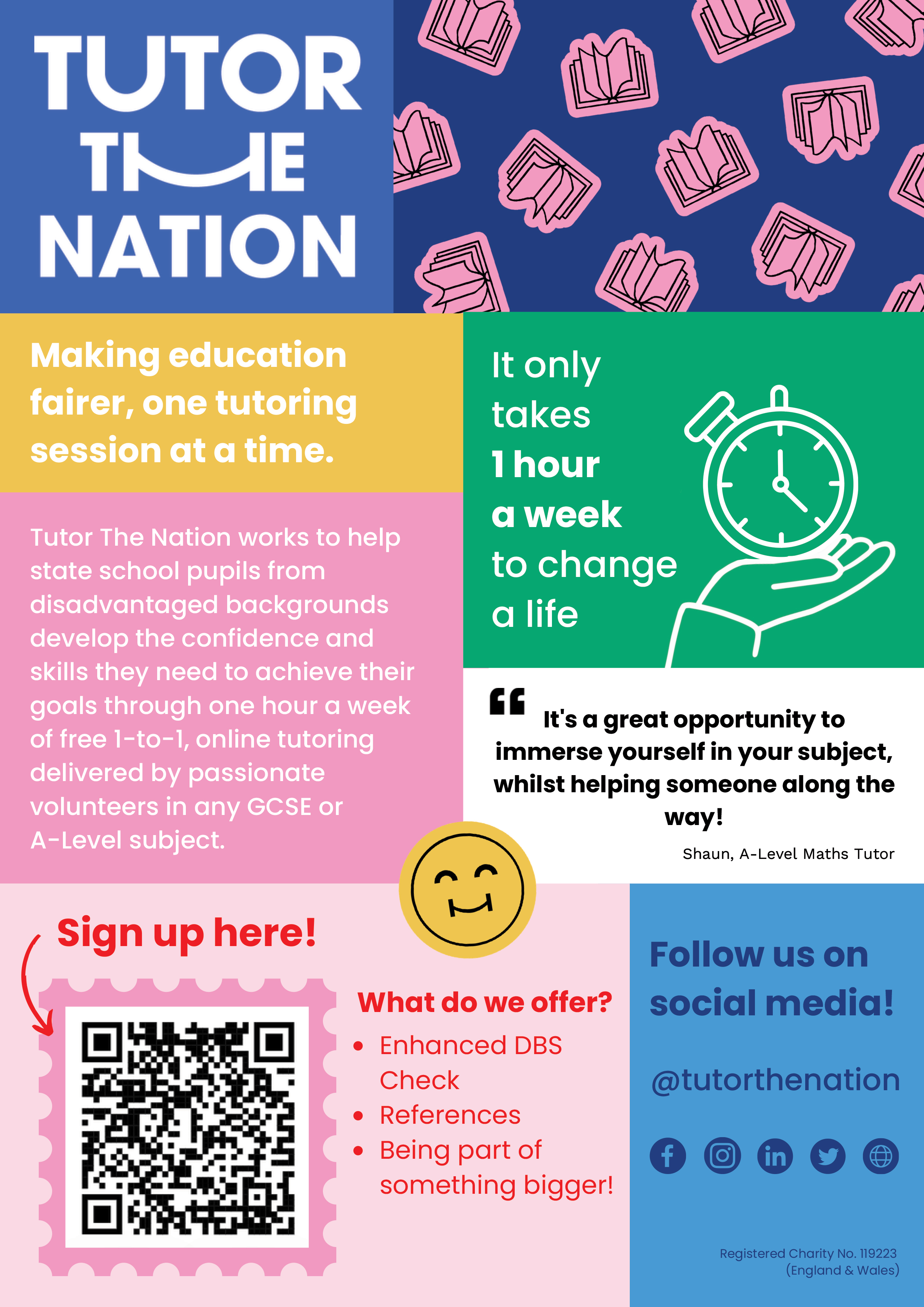
Tutor The Nation (TTN) is a UK charity that connects university volunteers with under-resourced GCSE and A-Level pupils in state schools with free, one-to-one online tutoring.
Since 2020, TTN volunteers have delivered over 23,000 hours of tuition to over 1,700 pupils. It was founded by Honorary Fellow of St Hugh’s College, and PPE Alumna, Jacky Lambert.
We spoke to Jacky and asked her about her passion for this critically important educational work.
What inspired you to found Tutor the Nation back in 2020, and how did your time studying PPE at Oxford shape that decision?
Although TTN was set up in 2020 during the pandemic, it was not set up as a pandemic response only. The idea was to harness students to underpin the state education sector in the UK, prioritising areas of rural isolation and urban deprivation and thus tacking social mobility, PPE is a degree that touches on all aspects of what TTN is aiming to achieve: ethical questions of what constitutes a fair society in an economically unequal system.
Was there a particular moment during your studies or early career that made you realise the scale of educational inequality in the UK?
Being Korean, the two-tier education system in the UK was new and surprising to me. I felt that it was divisive but also that abolishing a long-established independent system would not be the answer as it would overwhelm an already challenged State sector. To my mind, it was preferable to level up education in the State sector by embedding 20 to 40 tutors per school and over time, the incentive to choose between the two systems would hopefully disappear. This is much the case in most countries where which school you attend is largely dictated by locally rather than quality.
 How did your academic background in PPE influence the way you designed TTN’s model?
PPE is a discipline which teaches you to think clearly and logically and to look at societal issues: Philosophy leads you to look at moral issues, Politics allows you to explore societal problems and to think of ways to mitigate them and Economics is the engine that drives growth. TTN was designed as a model that could deliver societal change effectively and economically as building our own online tutoring platform allows us to reach anywhere in the UK.
TTN has delivered over 22,000 hours of tutoring—what impact stories have stayed with you the most?
TTN is one of the few tutoring (not just mentoring) charities that will support all children, not just those who aspire to go to university. The stories that I have found most uplifting are ones in which a child says that, due to the support of their tutor, they feel they have decided to try for a place to study, a profession of choice which they felt was out of their reach.
Why are university students—especially those at DPIR —well placed to make a difference as tutors?
DPIR students are all gifted academically so tutoring for them is not difficult as by definition of being there, they achieved the highest marks at school; tutoring involves scaffolding a tutee’s weakness, not teaching the curriculum. The additional attribute is that PPE students study ethics and are asked to confront moral dilemmas in an imperfect world. Politics studies solutions to these dilemmas and Economics gives you an idea of the tools that can be used to level up.
What do student-volunteers typically gain from the experience, both personally and professionally?
We find that tutoring has a positive effect on both tutee and tutor. Specific to tutors is increase in confidence, enhancement of leadership skills and a positive effect on the tutor’s mental health. In addition, many top corporates have told us that they value volunteering on an applicant's CV.
Beyond academic grades, how does tutoring change pupils’ confidence and aspirations?
As we work with schools with high pupil premium, our pupils mostly come from families where there is very little conversation on academic subjects, but more importantly, on building confidence, encouraging aspiration and hence literacy and numeracy matter in all ways of life. The tutors themselves are a positive role model to their pupils and have a very powerful effect as the message is “ I am here for you every week, unpaid, to help you be the best of you”.
How can universities and departments like DPIR play a bigger role in supporting initiatives like Tutor the Nation?
I would like universities in the UK to embed volunteering into the system so that students understand that they who have achieved so much themselves, can give back and each increment adds up to make societal change.
Finally, if you could say one thing directly to DPIR students considering volunteering, what would it be?
“Please give an hour a week to make a profound change in a child’s life outcome”.