


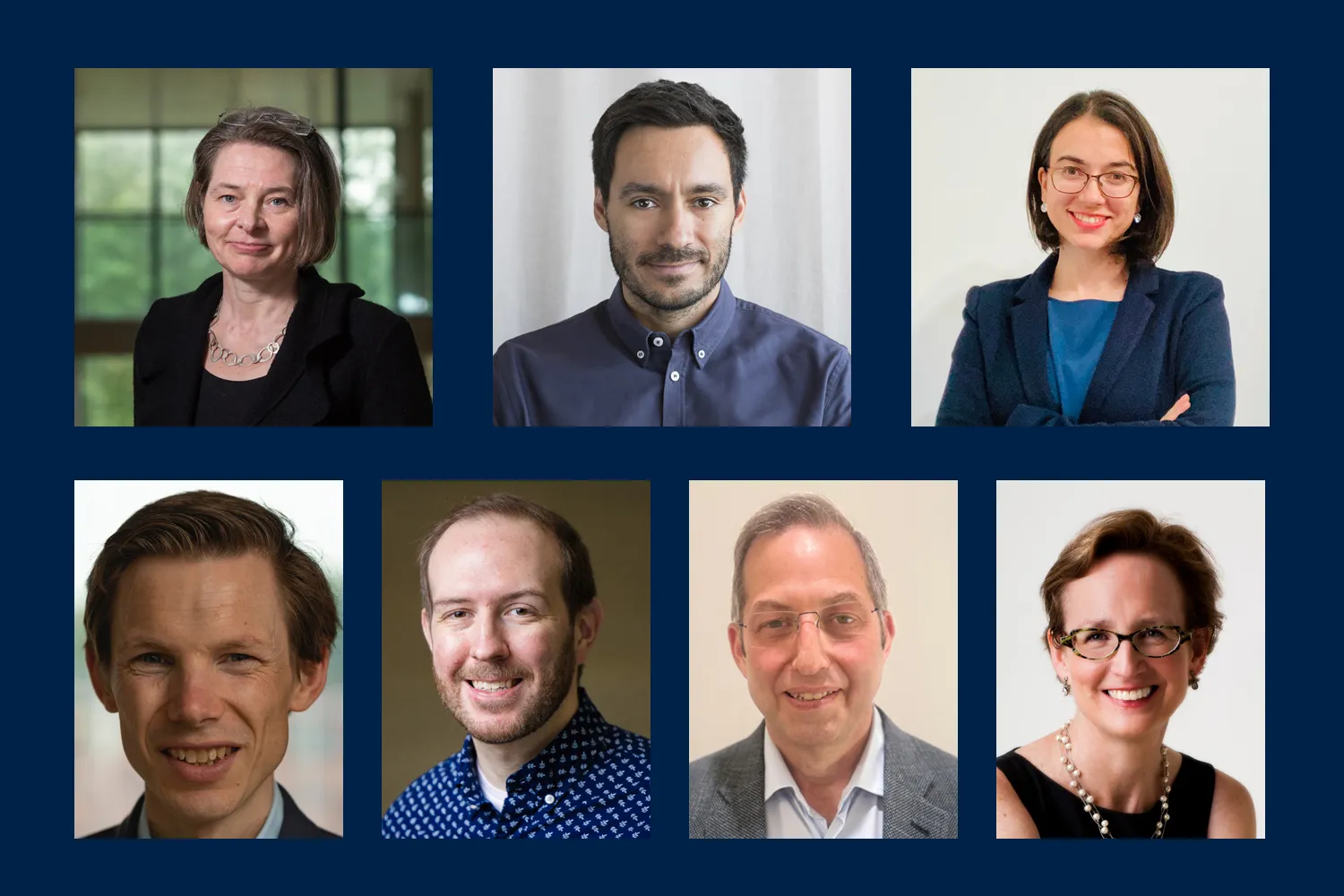
Professor Petra Schleiter
Petra Schleiter is the Director of the Centre for Democratic Resilience at the University of Oxford. She is a Professor of Comparative Politics with extensive senior research and academic leadership experience. With more than 60 publications, Petra is a prominent scholar in the field of democratic institutions and institutional reform, party competition, and policy reform.
Petra regularly serves as an expert witness to policy makers and advised the Irish Citizens Assembly in 2018. Her contributions have been recognised by elections to fellowships by the Institute of Advanced Studies in Berlin (2024-25), AxPo (Sciences Po,Paris) (2026), and the Constitution Unit of University College London (2015-present) among others.
Email Petra Schleiter.
Professor Tarik Abou-Chadi
Professor Tarik Abou-Chadi is Professor of European Politics at the University of Oxford. He is leading the initiative for a Societal Resilience Lab within the Centre for Democratic Resilience.
Tarik is a leading expert on the rise of the far right and the crisis of mainstream parties in Europe. He co-founded the Progressive Politics Research Network - an initiative to make political science research more accessible for political practitioners and the broader public. His work has been recognised with the inaugural Henrik Enderlein Prize for research excellence in the social sciences awarded by the German and French government.
In addition, Tarik’s research and work includes:
Progressive Politics Research Network: A collaborative effort to make research more accessible to journalists, political practitioners and the wider public. Within PPRNet we have so far published 10 research briefs summarizing cutting-edge research on pressing political topics.
Podcast series Transformation of European Politics (host and producer).
Next Left lecture. Foundation for European Progressive Studies. At the European Parliament. Video Link
- Hear more from Tarik on the Migration Oxford Podcast talking about the German and American far right and the issue of immigration
Email Tarik Abou-Chadi.
Professor Katerina Tertytchnaya
Professor Katerina Tertytchnaya is Associate Professor in Comparative Politics at the University of Oxford.
With publications in the discipline’s flagship journals, and over half a million in external research income, Katerina is a prominent scholar in the field of authoritarian politics.
Katerina focuses on the study of political behaviour, protests, and contemporary Russia. Among others, her research has been published in the Washington Post and the New York Times.
A UKRI Future Leaders Fellow, Katerina has been interviewed for the BBC World Service, History Hour Podcast and BBC Radio 4.
Professor Edward Brooks
Professor Edward Brooks is Director of the Programme for Global Leadership at the Department of Politics and International Relations, Executive Director of the Oxford Character Project, and Co-founder of the Oxford SDG Impact Lab.
His work joins research in leadership studies, virtue ethics, and character development to the design and delivery of leadership programmes at the University of Oxford and institutions around the world. Current projects focus on hope and multilateralism, resilience as a democratic civic virtue, exemplarity in public leadership, the role of AI in leadership development, and the role of universities in leadership development in lower- and middle-income countries.
He has worked extensively with the private sector, heading a £2.6m research project investigating the relationship between culture, character and leadership with a focus on finance, law and technology firms. Ed has collaborated with several United Nations organisations and currently leads the University of Oxford’s collaboration with United Nations Academic Impact (UNAI).
He is an Expert Advisor of the Leadership Excellence in Politics Initiative, an Advisory Board Member of the Civic Humanism Center for Character and Professional Ethics at the University of Navarra, and a Senior Fellow of the Educating Character Initiative at Wake Forest University.
His work has been cited in media outlets such as the Financial Times, Wall Street Journal, New Scientist, Brunswick Review, and Starling Insights, and he has been named by global management network Thinkers 50 on their radar list of business and management thought leaders.
Professor Scott Williamson
Scott Williamson is Associate Professor of Comparative Political Economy at the University of Oxford.
With more than one million pounds in external funding and several publications in top academic journals, he is a prominent scholar of authoritarian politics and democratic backsliding.
Scott co-founded the Authoritarian Politics Network at Oxford, and he was elected to lead the Democracy & Autocracy Section of the American Political Science Association from 2025 to 2027.
He has published analyses for the Washington Post, the Carnegie Endowment for International Peace, and the Conversation, among others. He has also presented or given commentary to organizations including UNICEF, the Baker Institute for Public Policy, and the US Department of State.
Practitioner Associate, Derek Mitchell
Derek Mitchell is a senior adviser to the President and Asia Program at the Center for Strategic and International Studies (CSIS) in Washington D.C.
Between 2018 and 2023, Ambassador Mitchell was president of the National Democratic Institute, a U.S.-based non-profit, non-government organization dedicated to supporting democratic development worldwide, where he oversaw and led 1200+ personnel in 50+ offices worldwide.
An Asianist with nearly four decades of experience working in and on the region, from 2011-16, Mitchell served as US special envoy and then ambassador to Burma (Myanmar), the first in 22 years, during a historic period in the country’s nascent democratic transition. From 2009-11, Ambassador Mitchell oversaw the Obama Defense Department’s Asia policy as the Principal Deputy Assistant Secretary of Defense for Asian and Pacific Security Affairs, and acting Assistant Secretary.
From 2001-2009, he was senior fellow for Asia in CSIS’s International Security Programmes, where he founded the Center’s Southeast Asia Programmes. He has served as a senior advisor at the United States Institute of Peace, as well as a lecturer for the Stanford-in-Washington programme.
He is currently serving on the Board of Directors, Institute for Indo-Pacific Security; Patron, Hong Kong Watch (UK).
Mitchell has authored numerous articles, policy reports, and opinion pieces on Asian affairs, and is the coauthor of three books on China. He is currently working on a book about his experience in Burma entitled “Myanmar Days: A Chronicle of Diplomacy and Democracy,” to be published by Columbia University Press.
Practitioner Associate, Maria Balinska
From 2019 until November 2025, Maria Balinska served as Executive Director of the US-UK Fulbright Commission, working at the intersection of higher education, diplomacy, and global opportunity to support students, scholars, and future leaders on both sides of the Atlantic.
During her tenure at Fulbright, Balinska increased the number of fellowships paying all costs for UK postgraduate students in the US, making international exchange opportunities affordable and attractive to talented individuals, whatever their background or financial circumstance. She launched new initiatives such as the Fulbright Champions’ network designed to promote Fulbright opportunities across the higher education sector in the UK and the Global Challenges Teaching Awards, a programme that promotes excellence and innovation in virtual exchange between university classrooms in the US and UK.
By training a journalist, Balinska was on the launch team of The Conversation US, the non-profit news source that brings together journalists and academics to unlock research for the general public in a timely and accessible manner, and was its editor-in-chief from 2015 to 2019. Prior to this she ran her own digital start up, Latitude News, that promoted coverage of the parallels and connections between Americans and the rest of the world, coining the term “local-global mashup journalism.”
From 2009 to 2010, Balinska was a Nieman Fellow at Harvard University. This came after 18 years at the BBC in London where she began her journalism career reporting on the fall of communism in Eastern Europe. As Editor of Radio World Current Affairs from 1999 to 2009, Balinska led a team of award-winning specialist journalists producing over 150 hours of original journalism a year broadcast on four different BBC radio networks and online.
She has published opeds in the Times Higher, Nieman Reports (Harvard) and the Boston Globe. She has presented to organisations including the National Academy of Sciences, the Los Angeles Public Library, the American Association of Colleges & Universities and MIT’s Starr Forum. Her book of food history The Bagel: the surprising history of a modest bread (Yale University Press 2008) was described by the New York Times as ‘thought provoking ; and by the American Scholar as a ‘gem of culinary and social reportage.’
Tarik Abou-Chadi is Professor of European Politics at Oxford University and will lead the Societal Resilience Lab. He explains how his research is relevant to the Centre’s work.
Dr Edward Brooks is the Director of the Programme for Global Leadership and Executive Director of the Oxford Character Project. He explains the importance of leadership in liberal democracies.